


All reports are available for download here
Project
An indicatorbased monitoring of structural quality in the German early childhood education and care system (ERiK)
Term: 01.06.2019 - 31.12.2027
Short-URL: www.dji.de/ERIK

The ERiK project aims to develop an indicator-based monitoring instrument that captures both the current situation and changes in quality within the system of Early Childhood Education and Care (ECEC), providing both a nationwide overview and state-specific analyses. In addition, it takes into account the various stakeholders involved and their respective perspectives on quality. This includes:
- the (further) development of indicators and survey instruments relating to the structural conditions of quality in ECEC,
- the design, implementation, and analysis of multi-perspective survey data,
- the management, processing, and provision of data, and
- the publication of analyses and findings.
To reflect the perspectives of the different stakeholders, surveys are conducted among parents and children, youth welfare offices, childcare providers, daycare center directors and educational staff, as well as family daycare providers. Here you can find important information on the general background of the project.
Information about the project
Survey Methodogy and Data Management
Main areas of work of the small team: survey methodology and data management for the ERiK project.
ERiK Surveys 2026
Between March and August 2026, the fourth round of the ERiK Surveys will take place. They represent the largest parallel survey program conducted to date in the field of early childhood education and care (ECEC) in Germany.
Quality in Early Childhood Education and Care
What defines high-quality early childhood education and care, and how can quality be further enhanced? These are the key questions addressed by the ERiK project as part of the monitoring of Germany’s Second Daycare Quality Act.
Research Database
Survey datasets and accompanying documentation from previous ERiK survey waves are available for download and use in scientific research.
ERiK at Conferences in 2025
Members of the ERiK team gave presentations at conferences, sharing the latest data and results from the project.
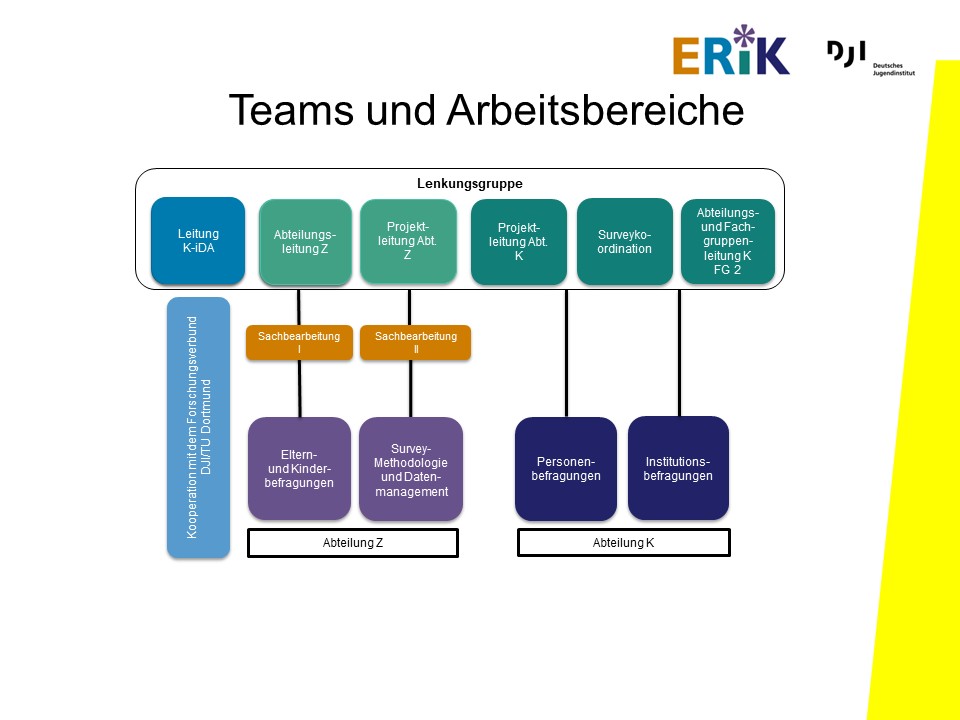
ERiK project team














Fargas-Malet, Montserrat/McSherry, Dominic/Larkin, Emma/Robinson, Clive (2010): Research with children: Methodological issues and innovative techniques. In: Journal of Early Childhood Research, 8. Jg., H. 2, S. 175–192
Kluczniok, Katharina/Roßbach, Hans-Günther (2014): Conceptions of educational quality for kindergartens. In: Zeitschrift für Erziehungswissenschaft, 17. Jg., H. 6, S. 145–158
Lipowski, Hilke/Wirner, Lisa (2019): Kindertagespflege im Wandel. In: DJI-Impulse. Frühe Bildung. Bilanz und Perspektiven für Deutschland. Nr. 121, H. 1, S. 25-29 [online unter: https://www.dji.de/fileadmin/user_upload/bulletin/d_bull_d/bull121_d/DJI_1_19_Web.pdf]
Mader, Marius/Menz, Margarete (2019): Steuerung im Elementarbereich – Qualitätssicherung und -entwicklung aus Sicht von Trägern. In: Diskurs Kindheits- und Jugendforschung, Jg. 14, H. 2, S. 213-226
Moss, Peter (2017): Power and resistance in early childhood education: From dominant discours to democratic experimentalism. In: Journal of Pedagogy, 8. Jg., H. 1, S. 11–32
Nentwig-Gesemann, Iris/Walther, Bastian/Thedinga, Minste (2017): Kita-Qualität aus Kindersicht. Eine Studie des DESI-Instituts im Auftrag der Deutschen Kinder- und Jugendstiftung. Deutsche Kinder- und Jugendstiftung & Institut für Demokratische Entwicklung und Soziale Integration (Hrsg.). Berlin
Schreyer, Inge/Krause, Martin/Brandl, Marion/Nicko, Oliver (2014): AQUA - Arbeitsplatz und Qualität in Kitas. Ergebnisse einer bundesweiten Befragung. München: Staatsinstitut für Frühpädagogik
Stöbe-Blossey, Sybille (2012): Governance und Qualität in der Elementarbildung. In: Ratermann, Monique/Stöbe-Blossey, Sybille (2012): Governance von Schul- und Elementarbildung – Vergleichende Betrachtungen und Ansätze der Vernetzung. Springer VS
Tietze, Wolfgang/Becker-Stoll, Fabienne/Bensel, Joachim/Eckhardt, Andrea/Haug-Schnabel, Gabriele/Kalicki, Bernhard/Keller, Heide/Leyendecker, Birgit (Hrsg.) (2013): NUBBEK. Nationale Untersuchung zur Bildung, Betreuung und Erziehung in der frühen Kindheit. Berlin
Viernickel, Susanne/Nentwig-Gesemann, Iris/Nicolai, Katharina/Schwarz, Stefanie/Zenker, Luise (2013): Schlüssel zu guter Bildung, Erziehung und Betreuung. Bildungsaufgaben, Zeitkontingente und strukturelle Rahmenbedingungen in Kindertageseinrichtungen. Berlin
Viernickel, Susanne/Fuchs-Rechlin, Kirsten/Strehmel, Petra/Preissing, Christa/Bensel, Joachim/Haug-Schnabel, Gabriele (2016): Qualität für alle. Wissenschaftliche begründete Standards für die Kindertagesbetreuung. Verlag Herder
Viernickel, Susanne/Schwarz, Stefanie (2009): Schlüssel zu guter Bildung, Erziehung und Betreuung. Wissenschaftliche Parameter zur Bestimmung der pädagogischen Fachkraft-Kind-Relation. Expertise. Berlin
Sponsored by:
-
© David Aussenhofer
